


Do Duy Hoa1†, Bui Van Dung2†, Nguyen Hoai Nam2 , Nguyen Duc Truong2, Nguyen Van Phuong1, Dan The Ngo1, Tran Thi Duc Tam3, Pham Thi Lan Huong4, Ha Xuan Bo5, Le Van Truong6, Le Van Phan6, Mai Thi Ngan6*
1Boehringer Ingelheim Animal Health Vietnam Limited Liability Company, Ho Chi Minh, Vietnam
2Department of Animal Surgery and Theriogenology, Faculty of Veterinary Medicine, Vietnam National University of Agriculture, Ha Noi, Viet Nam
3 Department of Veterinary Anatomy, Histology and Embryology, Faculty of Veterinary Medicine, Vietnam National University of Agriculture, Hanoi, Vietnam
4Department of Pharmacology, Toxicology, Internal Medicine and Diagnostics, Faculty of Veterinary Medicine, Vietnam National University of Agriculture, Ha Noi, Vietnam
5Department of Animal Genetics and Breeding, Faculty of Animal Science, Vietnam National University of Agriculture, Hanoi, Vietnam
6Department of Veterinary Microbiology and Infectious Diseases, Faculty of Veterinary Medicine, Vietnam National University of Agriculture, Hanoi, Vietnam
† These authors contribute equally
* Corresponding author
Dr. Mai Thi Ngan, Department of Veterinary Microbiology and Infectious Diseases, Faculty of Veterinary Medicine, Vietnam National University of Agriculture, Hanoi, Vietnam
Email address: mtngan@vnua.edu.vn
Abstract
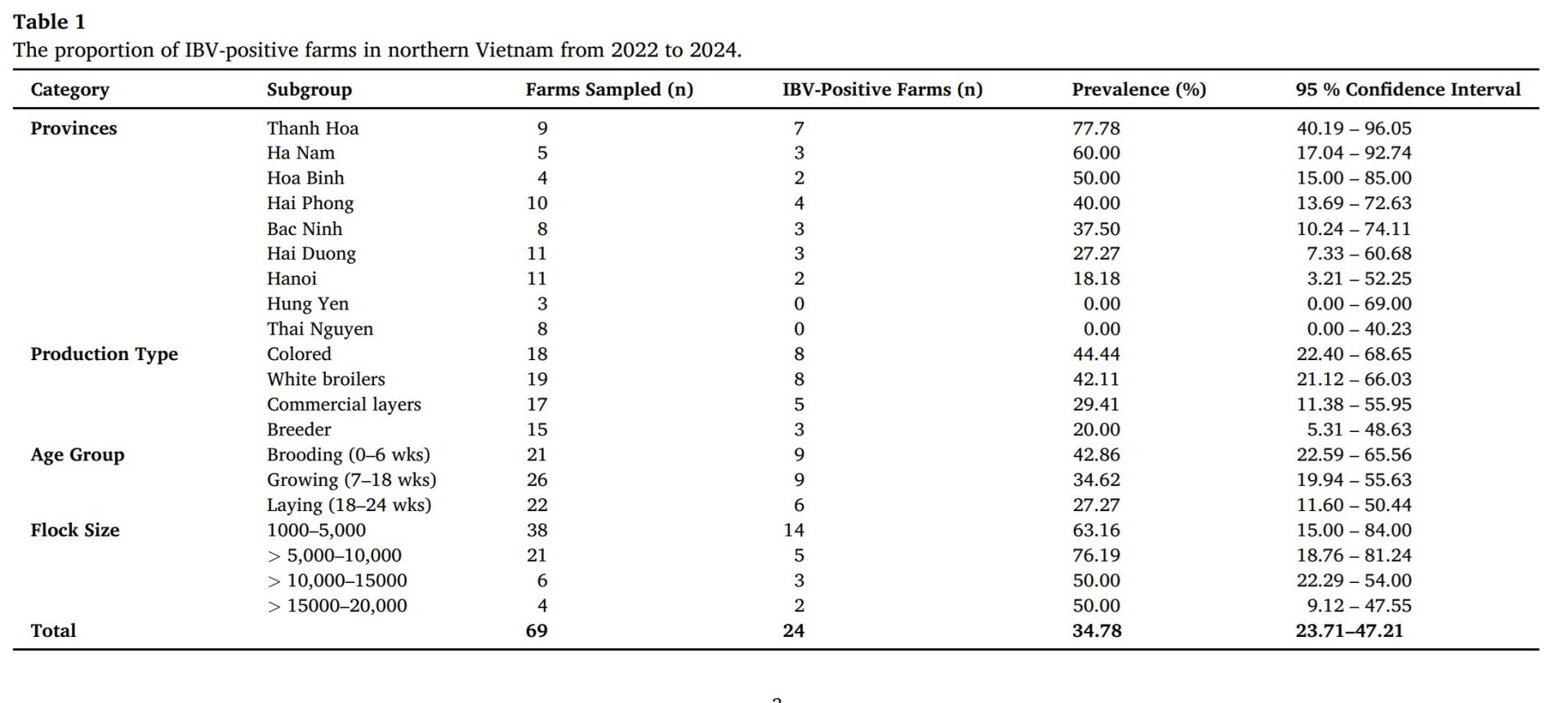
Infectious bronchitis virus (IBV) remains a major respiratory pathogen of economic concern in the poultry industry. This study investigated the farm-level prevalence of IBV and evaluated associated risk factors in northern Vietnam by a cross-sectional study. A total of 69 poultry farms were surveyed, and pooled tracheal swab samples were tested using RT-qPCR for IBV detection. The overall IBV farm-level prevalence was 34.78%. No significant variation in prevalence was observed across provinces or production types. A total of 22 potential risk factors were initially assessed using univariate logistic regression. Of these, six variables with P < 0.1, including farm size, number of poultry houses, presence of multiple age groups, vaccination at day-old, frequency of disinfection before chick placement, and proximity to live bird markets and residential areas, were selected for multivariable logistic regression. The final multivariable model retained two independent predictors: performing more than one disinfection before chick placement (P = 0.035), and administration of a live IB vaccine at one day of age (P = 0.006), both of which were significantly associated with reduced the odds of IBV infection at the farm level. These findings suggest that strategic vaccination and careful calibration of disinfection protocols are critical to minimizing IBV transmission at the farm level.
Keywords: Cross-sectional study, Infectious bronchitis virus, risk factors, prevalence, Vietnam
DOI: https://doi.org/10.1016/j.prevetmed.2025.106734

 English